This is a blog, dedicated to anything to do with the automobile. I'll bring you things like my favorites in a list by importance, different cars, different days. my take on certain cars and their affect on history. I hope to expand my content as ideas come to me.
If you watched Furious 7, then you undoubtedly jumped out of your seat when you saw a $3.4 million supercar toss itself out the window of a skyscraper. That car was the 770-horsepower Lykan Hypersport, and it was the brainchild of Dubai-based W Motors—though, don’t worry, the one in the movie was just a prop. Now, W Motors is getting ready to start selling its latest creation, the 900-horsepower Fenyr Supersport. A worthy addition to the already insane lineup, the Supersport is a stunning car from front to back, and its unique active spoiler is absolutely mesmerizing to watch.
The Triptych Active Spoiler is made of three separate moving sections. Each section deploys independently through an electro-mechanical system that ensures they all move in perfect sync with each other. It’s like watching a crazed mechanical ballet.
Both of the side panels automatically deploy first at roughly 50 mph. The main master panel deploys a bit later when the car reaches a speed of about 75 mph. At lower speeds, all three panels fold back into place and look like they’re simply sculpted sections of the overall body.
There will only be 25 units of the Fenyr Supersport produced per year, so it’s not going to be easy to find or afford. Power comes from a custom flat six-cylinder, 4.0-liter, twin turbo, mid-rear engine. This is paired to a 7-speed double clutch gearbox. It will have 900 horsepower, which means you’ll be going fast enough to have that spoiler deployed pretty much all the time.
There are fast cars, and then there’s the Dodge Viper SRT. It’s a bit of a dinosaur, technically speaking—what with its 8.4-liter V10, and very minimal electronic interference. Next year is the end of the line for the revived supercar, but that doesn’t mean it’s still not out there trying to prove itself.
Case in point, the guys who have been working on this fifth-generation Viper and doing their best to set a top speed record. It currently boasts around 1,500 horsepower, with a final goal of 200 mph in the half-mile on 19-inch tires, which is no small feat to manage.
There’s nothing riding on this, just a sense of accomplishment from a group of guys who clearly enjoy their work. They show off their efforts at Heaven’s Landing Airstrip down in Clayton, Georgia.
The driver says it’s an internal goal, nothing they have to do, but something they all want to try and pull off. He makes a couple of runs and comes in just under the 200 mph he’s trying to hit.
Eventually, he hits the target and sets a new record for the fastest fifth-generation Viper in the half-mile.
Watch and see how fast he manages to send the Viper down the track.
To millions of gearheads, the name “Stingray” is almost sacred. You could write a book on the history of the Corvette (and plenty of people have), dating back to the original plastic fantastic model from 1953, but to legions of fans, the Corvette didn’t truly earn its stripes until the second-generation Stingray debuted in 1963.
The name has become shorthand for the the golden age of performance in America, all big block V8s, red line tires, and space-age design. The original Stingray may have had the shortest lifespan of any Corvette — just five model years — but its legacy is felt more than half a century later in the current Corvette, considered by many to be the best of the breed.
The ’53-’62 ‘Vettes had a difficult gestation period, with early cars suffering from uneven build quality (largely due to use of a new material called fiberglass) and a woefully inadequate inline six pared to a two-speed automatic transmission.
The 1955 car benefited from an overhead valve V8 and standard three-speed manual, and the ’57s had the optional (and now legendary) fuel injected V8, but from ’58 to ’60, the car became weighed down with heavy chrome flourishes, and despite a significant refresh for ’61-’62, the car was beginning to show its age.
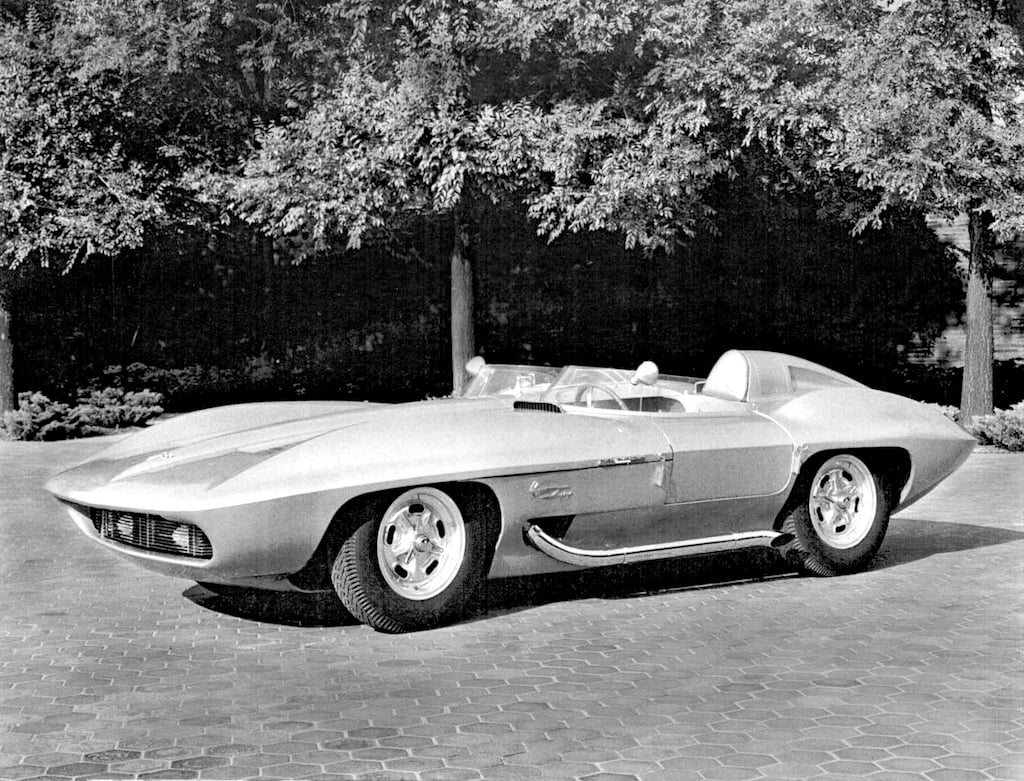
1959 Corvette Sting Ray Racer | Source: Chevrolet
But the genesis of the Stingray began much further back as early as 1957, with the new model slated to arrive for the 1960 model year. Chief engineer Zora Arkus-Duntov and his staff began work on the “Q-Corvette,” a smaller, lighter model with cutting-edge features like a rear-mounted transaxle (for better weight distribution), independent rear suspension, four-wheel disc brakes, and a sleek coupe body penned by a 21-year-old stylist named Pete Brock, who would go on to design the Shelby Daytona Coupe.
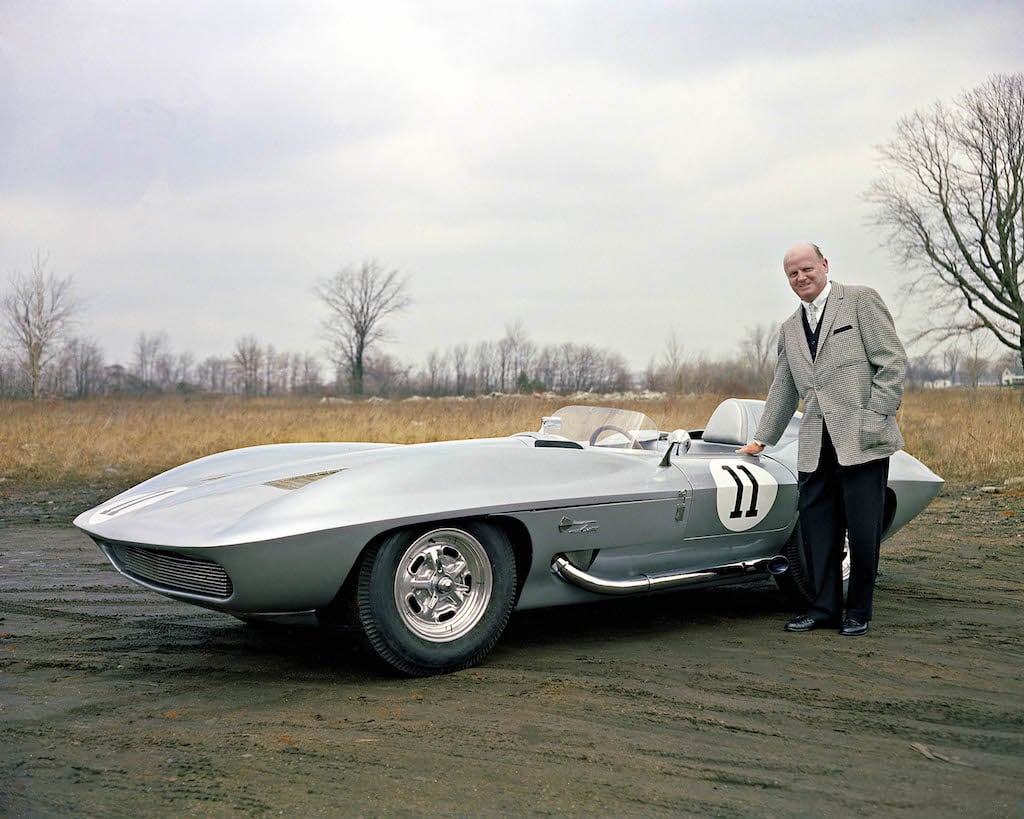
Then, the development of the Stingray split: During the the recession of 1957, GM brass killed the expensive program much to the dismay of styling director Bill Mitchell, who bought the car, and with covert help from a crew of GM engineers, turned the Q-Corvette into an SCCA racer, the 1959 Sting Ray Corvette.
While Mitchell was off winning races, Arkus-Duntov and his team had moved on to build the mid-engined CERV (Chevrolet Experimental Racing Vehicle), an engineering concept designed to showcase his innovations developed for the Q-Corvette, and make them more palatable for the men holding the purse strings.
In 1961, Mitchell ordered a young designer named Larry Shinoda (who would go on to design the 1970-’73 Ford Mustang) to improve on Brock’s design for a production version, and in 1960, the next-generation Corvette was given the green light by GM.
Bill Mitchell with the ’59 Sting Ray Racer
| Source: General Motors
Bill Mitchell was in the business of transforming GM’s cars into dream machines; to him, function followed form. But to Arkus-Duntov, the new Corvette needed to perform at least as well as it looked. Four-wheel discs and the rear-mounted transaxle went out the window to keep costs down, but he held firm on the independent rear suspension, and in the end Mitchell acquiesced to the expensive setup.
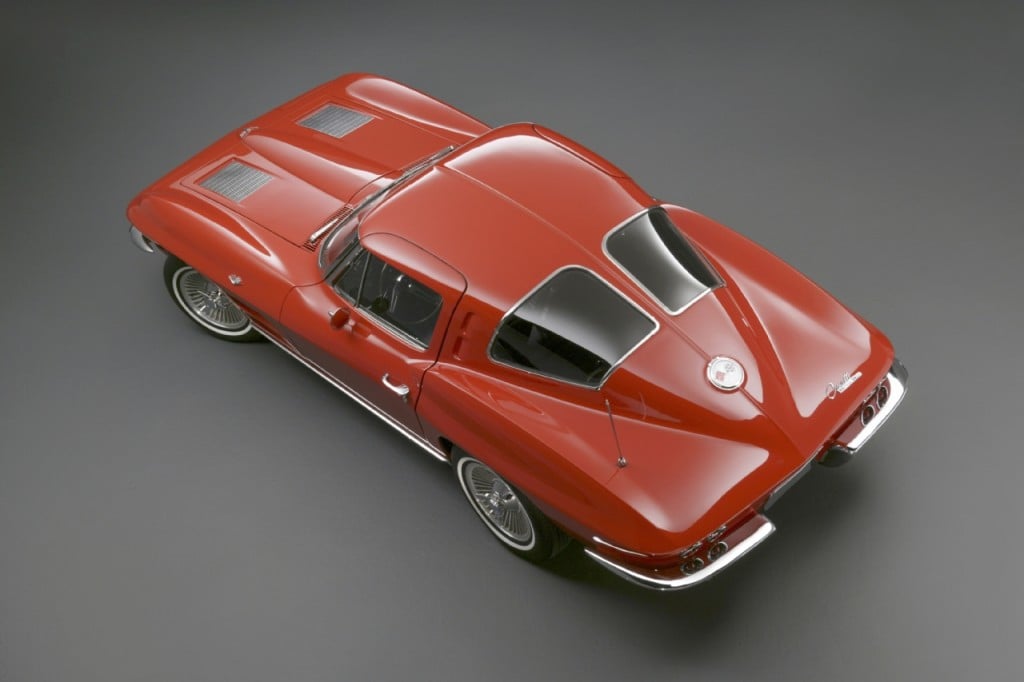
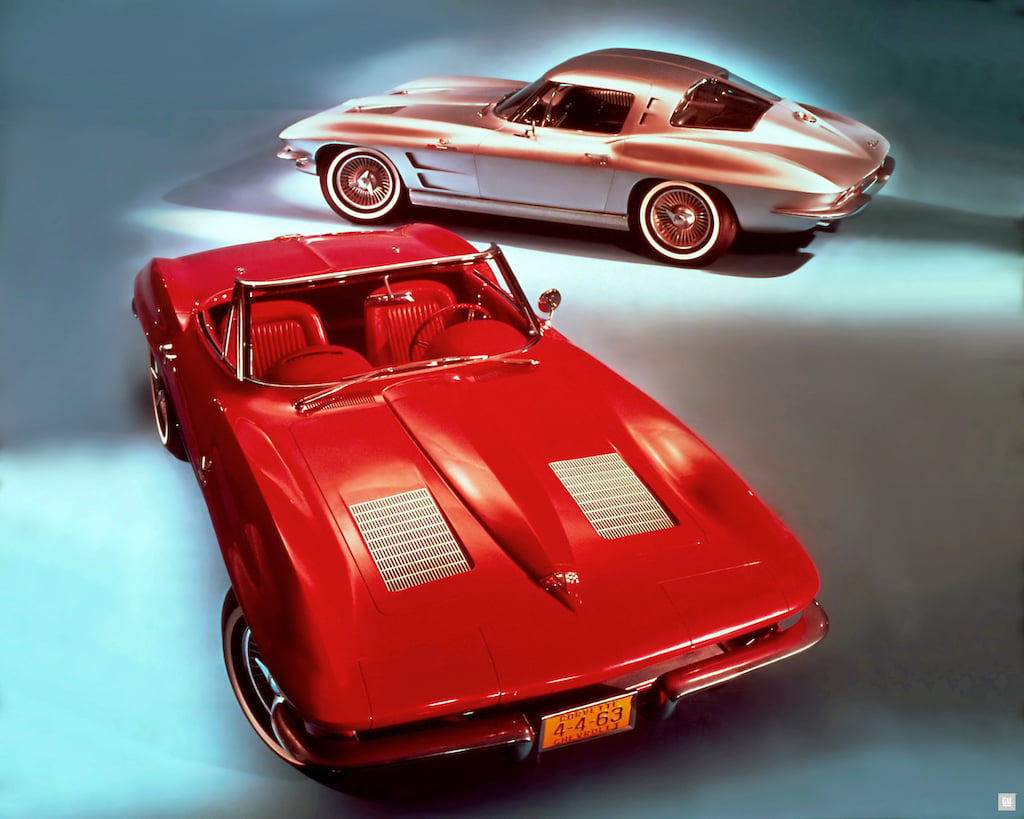
The Stingray would turn out to be one of the era’s best performance cars, but that didn’t matter when it debuted as a coupe and convertible in October 1962. With its hideaway headlights (the first on an American car since the ’42 DeSoto), fastback fuselage, and split rear window, it combined elements of European sports cars like the Jaguar E-Type and Ferrari 250GT, but with American space-age styling touches, especially on the interior.
1963 Corvette Sting Rays | Source: Chevrolet
The automotive press fell for the Sting Ray (introduced as two words) fast. Car and Driver said:
One glance at the new Corvette tells you that it is faster and sportier than its predecessors. And when you drive a Corvette Sting Ray, either the convertible or the fastback Sport Coupé, you find that the excitement is far more than skindeep. Hiding independent rear suspension under its sculptured tail, the Corvette is now second to no other production sports car in road-holding and is still the most powerful.
As a purely sporting car, the new Corvette will know few peers on road or track. It has proved, in its “stone-age form,” the master of most production-line competitors; in its nice, shiny new concept it ought to be nearly unbeatable.
What’s more, the press vindicated Arkus-Duntov and his expensive IRS setup. In the same review, Road and Track declared:
In a word, the new Sting Ray sticks! Whether you slam the car through an S-bend at 85 or pop the clutch at 5000 rpm at the drag strip, the result is the same — great gripping gobs of traction.
At $4,037 (around $32,000 today), the Corvette was a bargain compared to the E-Type and Porsche 356, and could keep up with them in nearly anything. After a decade of trial-and-error, “America’s Sports Car” had become world-class, and it became the best-selling ‘Vette to date.
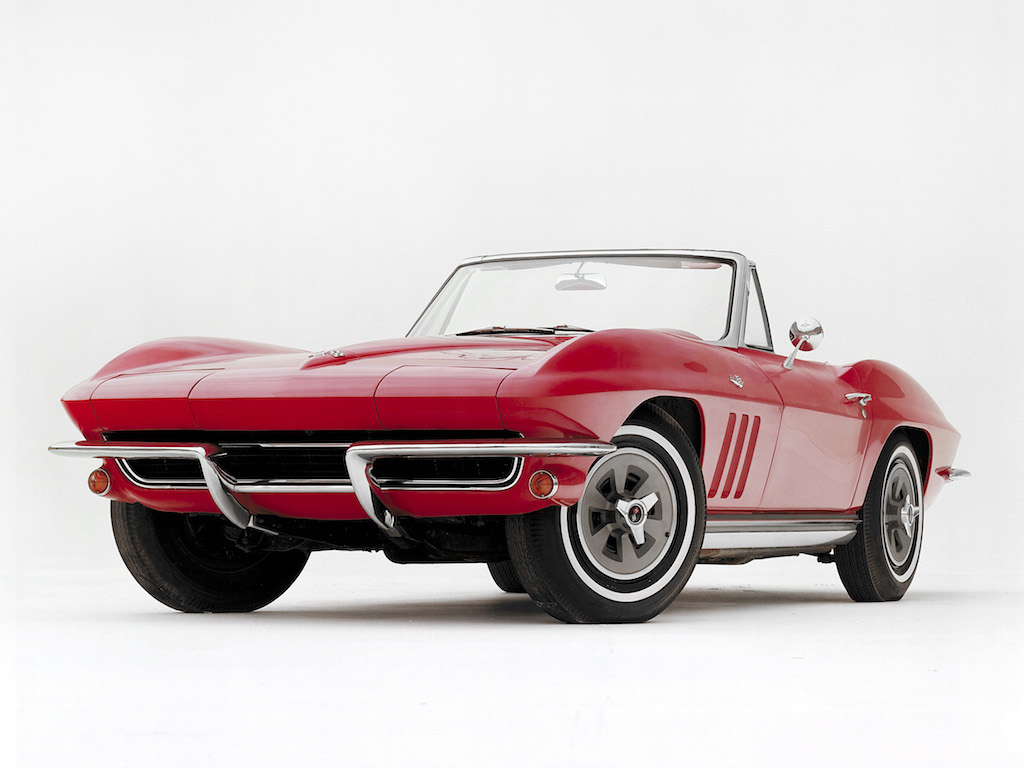
1965 Corvette Sting Ray Convertible | Source: Chevrolet
For 1964, Chevy shattered its year-old sales record with a mildly revised car. The distinctive split rear window was replaced by a more practical single piece of glass, and it lost its dual hood vents. Other than a slight horsepower bump — 365 versus 360 in ’63 — on performance models (standard 327 cubic inch cars made 260 horsepower), the car was otherwise unchanged.
Chevrolet had brought a mildly customized Sting Ray to the 1964 World’s Fair, where it was to be the centerpiece of GM’s auto display. But it was upstaged by Ford’s all-new ponycar, the Mustang. By 1965, with the Mustang a runaway success, American car buyers had officially gone crazy for horsepower.
The Mustang was never in the same league as the ‘Vette, but the Chevy did benefit from a notable power bump. That year, it introduced the big block 396, which cranked out an impressive 425 horsepower. For ’65, the Sting Ray also came one step closer to Arkus-Duntov’s ideal and got four-wheel disc brakes, a feature generally found only on high-end sports cars for the era. To go with the added power and better brakes, the ’65 Sting Ray got big fender vents to go along with them.
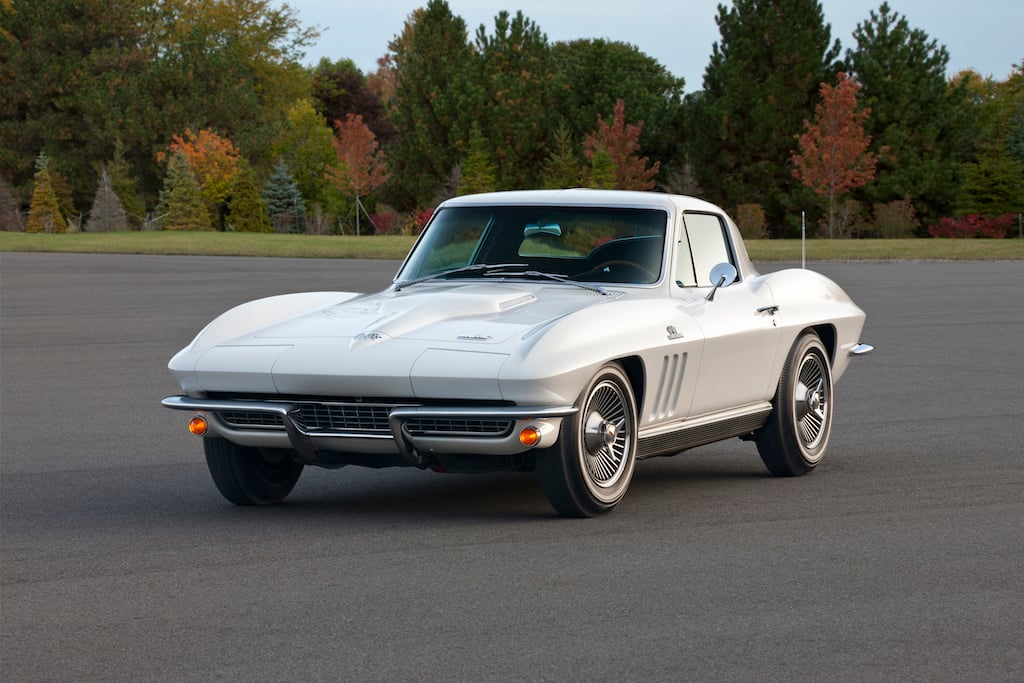
1966 Corvette Sting Ray Coupe | Source: Chevrolet
As the rest of Chevy’s lineup began to gain more of a performance edge, the range-topping Sting Ray got even hotter in 1966. Both 390- and 425-horsepower big block engines became available, and base cars now made an even 300 horsepower. But the sports car world was changing fast.
Lamborghini had stunned the automotive world with the mid-engined Miura, pointing to an even lower, leaner, angular future for sports cars. And the lowly muscle car was beginning to cut into the Corvette’s standing as America’s top sports car. What’s more, competitors like the Ford-powered Shelby Cobra were giving Corvettes a tough time on the race track. It was already time for a change, and Chevrolet decided that it needed to come in 1967.
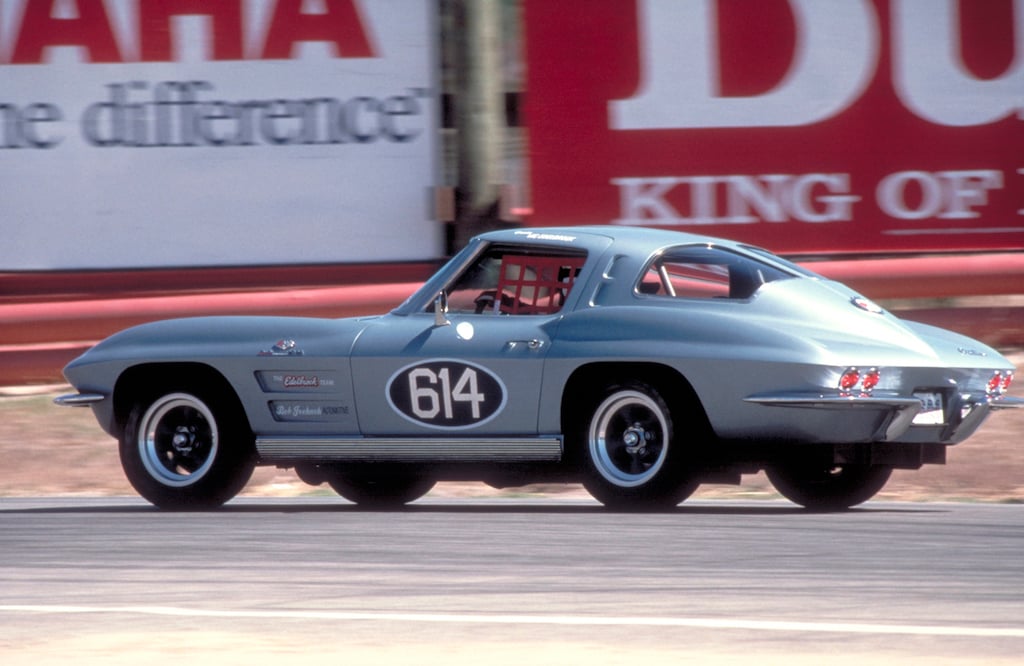
1963 Corvette Z06 Competition Car | Source: Chevrolet
But again, Arkus-Duntov dragged his heels on the new Corvette, now called Stingray (one word). It just wasn’t ready yet, so Chevy brought out a largely unchanged Sting Ray for one more year, and it became one for the ages. The 1967 model benefitted from every incremental change the Corvette team made over its five-year production run, and the range-topping L88 model, a factory-prepped drag car could crank out 560 horsepower from its high-compression 427. With just 20 produced, it’s one of the most sought after Corvettes ever built.
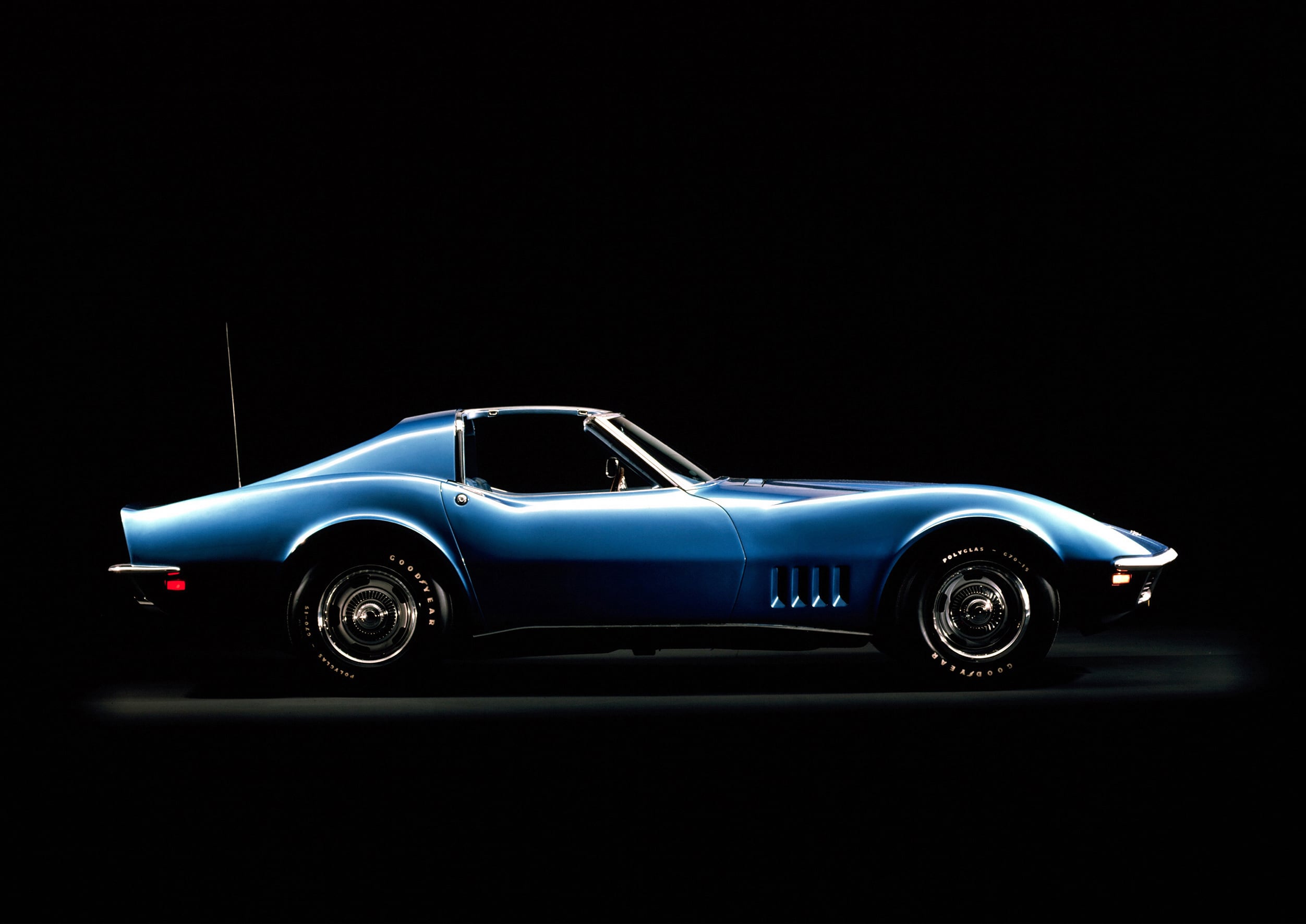
The third-generation Stingray debuted for 1968, and even after its extra year of development, it was plagued with a number of problems. But it was lower, sleeker, and had a sexy Ferrari-esque “Coke-bottle” shape. Despite the teething issues and a $400 price bump, the new car sold nearly 30,000 units its first year, a new Corvette sales record.
1968 Stingray Corvette | Source: Chevrolet
But the Stingray had the misfortune of weathering the oil crisis of the early ’70s, the bloat of the Malaise Era at the end of that decade, and a few awkward years of withering on the vine in the early ’80s. By the time it left production, it was slow, ancient, and out of style. The original Sting Ray never had that problem. It was only here for five years — each one better than the last — and went out as one of the most popular Corvettes of all-time.
After years in the wilderness, there may be a growing appreciation of the C3 Stingray, but the C2 is the darling of the collectors, and when Chevy reintroduced the nameplate for the current car, you can bet that it was channeling the sleek, red-hot car of the ’60s rather than the tired cruiser of the ’70s. The Sting Ray is a legend, and as time goes on, it will only grow in stature.
As you might expect, the upcoming Greenwich Concours d’Elegance Auction will see a variety of interesting cars roll across the block, and this 1966 Shelby GT350 is certainly among the best of the best. Boasting a race-ready interior, refurbished exterior, and even a spare 305 engine, it is, without question, a Shelby worthy of the estimated $100k-$130k asking price.
Chassis number SFM652235 was sold by Hickey Ford Inc. of Royal Oak Michigan, and came optioned with chrome wheels, a radio, and a rear seat. These bits are of course long gone, but serve as a reminder of the pedigree of this particular car. Three decades after it left the dealership the car was completely refurbished, and by the look of things, no expense was spared.
In preparation for the 1997 London to Sydney Rally the car received modifications to the suspension, brakes, steering, transmission, rear end, and fuel system. A full FIA spec roll cage was fitted, along with FIA approved seats, rally computers and a fire system. This is a turn key race car in the truest sense of the phrase, and though it’s street legal, you’ll want to get it out on the track to fully enjoy all 450-horses offered by the 289ci OHV V8.
As one always hopes would be the case, but is often not, the cosmetic quality of this example matches its performance capability. The car was resprayed in its original Sapphire Blue color and it appears to have held up quite well over the past 19 years. The 7×15 American Racing wheels are par for the course, and while they don’t look bad, I’d personally swap them out for an OEM set of Shelby 10 spokes with Goodyear rubber on them. That’s just me.
The overall aesthetic of the car is very much on point, it’s eye catching, but not over the top like so many Shelby projects tend to be.
Although this car was prepped specifically for the 1997 London to Sydney Rally, it didn’t participate because the transport plane it was on broke down. Following that bizarre turn of events the car went unused until it was sold to the current owner who has limited mileage, and kept the car in top notch condition.
As mentioned at the outset of this article, the car comes with an extra 305 engine, and it’s also worth noting that when the car was sold to the current owner it was reported that the 289 was a Roush built unit. I assume that means that Roush rebuilt the original engine, but it’s definitely something worth getting to the bottom of if you’re seriously interested in this car.
Either way, it’s a very appealing package that will bring some Mustang fan a lot of joy, especially if they make full use of its capabilities. I’d hope to see this car out at some vintage motorsport events and not stashed in some warehouse collection collecting dust. Anybody got a spare $130k they want to loan me?
Late last year, Mazda pulled the covers off one of its most striking concept cars to date—the Mazda RX-Vision concept—a two-door, two-seat, rotary-powered coupe, which was seen by many in the industry as a thinly veiled precursor to a next-generation Mazda RX-7 or RX-8 sports car.
There’s just one problem: due to tightening emissions and fuel efficiency regulations, creating a viable Wankel rotary engine for such a car has proven incredibly difficult; in fact, it’s the reason one hasn’t surfaced since the RX-8’s untimely departure in 2012.
Nevertheless, Mazda has remained steadfast in its desire to bring the rotary-powered sports car back to the market, a notion recently reiterated by the company’s European design director, Kevin Rice.
At last weekend’s Villa d’Este concours d’elegance, Rice told Top Gear, “we’d love to build it,” and later noted of the rotary engine, “in the back rooms at Mazda, we’re still developing it, and when the world’s ready to buy another rotary, we’ll be ready to provide it.”
So there you go people of the world, start pleading. We’re ready.
Regarding the concept car’s long, sultry hood, Rice notes the RX-Vision was always intended to house a rotary engine beneath it, saying, “nobody else would have developed the rotary engine. We thought we could get something good out of it, which we did, but we never stopped developing it. We didn’t just leave it with the RX-8.”
This jibes well with recent Mazda patent filings which show Mazda’s in-development “Skyactiv-R” rotary to be a departure from its non-conforming RX-8 “Renesis” engine. Major design shifts include relocated intake and exhaust ports, a repositioned turbocharger, and dual exhaust catalysts. This could mean a potentially much more powerful and much more emissions-friendly engine.
Rice also elaborated on the design team’s goal of giving the RX-Vision concept a taste of the ‘60s and ‘70s Italian sports cars, which as he says, were “pure, very clean and very exciting,” compared to today’s “busier” car designs.
“We respect those values of purity and beauty,” notes Rice. “They were valid then, and—if nobody else wants to do it—we want to resurrect those values.” Let’s hope the company does, at least for one last Mazda RX-7 hurrah.
If you’re talking about a day at the track, you have to talk about pressure; tire pressure, throttle pressure, braking pressure, boost pressure—there’s all kinds of pressure one needs to take into consideration. Even then, there’s no pressure greater than that which is put on you when it’s your turn behind the wheel of a car for the first time…in front of the owner, the builders, and one of your favorite motorsport athletes.
Sweltering afternoon heat only further amplifies things, as does the knowledge that the car in which you find yourself is a one-off build. Oh, and that’s right, you’ve never driven this track before, and there are no cones to help you learn the braking zones or find the apexes. You’re also the last one in, which means all eyes are on you.
Pressure from every damn direction.
The wrong thing to do is try and ignore it, you’ve got to let yourself feel it, only then will you be able to manage it. The first couple of laps I struggled to take my own advice, my driving was sloppy and frantic. Instead of getting in a rhythm, I was trying to work everything out at once and impress the peanut gallery, like it was middle school and I was trying to kickflip off a curb, bro. Except this time I wasn’t on a skateboard, I was behind the wheel of a supercharged Acura NSX.
Clarion took that rinky dink 3.0-liter V6 that came in the ’91 NSX, and tossed it out in favor of the 3.2-liter DOHC VTEC power-plant found in the ’97-’04 models. And because 290 horsepower, and 224 lb-ft of torque wasn’t enough, a Comptech supercharger kit was added to the mix.
Comptech also provided the software needed to manage the setup, while AEM took care of making sure it could breathe deeply with a cold-air intake, and custom exhaust. Conservatively rated at 350 horsepower, this thing feels a lot faster than the numbers would have you think, but a 3,010 pound chassis and a very low slung seating position tend to have that effect.
It’s one thing to feel like you’re going fast, but quite another to be told you’re going fast. Either way, Clarion made sure the NSX is able to handle that speed—or at least the feeling of which. A KW Variant 3 double adjustable coil over setup, and a superb, confidence inspiring, StopTech big brake kit were also added. Rounding out the safety blanket are Volk ZE40 wheels wrapped in Michelin Pilot Sport Cup 2 tires, which are great on the street and the track. I found that out firsthand.
My wakeup call came on the fourth lap when the car went into a slide courtesy of a very ill-advised lift mid corner. When the ass end of the NSX rotated towards the dirt, and the sound of screeching tires filled my ears, I felt all the pressure fade away.
I caught the slide, got back on the throttle, straightened the car out. Yes, I had screwed up, but I understood why, and now I knew that much more about the behavior of this NSX. That newfound knowledge gave me a sense of comfort that had been lacking up until that point, and for the remainder of my laps I was in sync with the car. Just me, a sexy, supercharged NSX, and a track. I pinched myself to make sure I wasn’t dreaming.
I wrung out second gear instead of needlessly going up to third, I braked later and harder, and I floored it down the back straight because that’s what you’re supposed to do in a car like this, damnit. There was nobody keeping track of my lap times, but I knew they were getting better, I could feel them getting better. I would later get unofficial visual confirmation that it did, indeed, appear that I was getting faster each lap, and frankly that’s good enough for me.
Maybe everyone was just being polite, but nobody heckled me about getting out of sorts in the one corner, nor did they comment that it looked as though I was totally lost out there. When pressed for reviews of my driving, the consensus seemed to be that I was fast, and had not pussyfooted around. Little did they know the car was doing most of the work.
All the newfound confidence was courtesy of one very put together vehicle. Rarely is a car more than the sum of its parts, but what the Clarion NSX adds up to is one of the more memorable vehicles I’ve had a chance to drive. Through all the reworking, it somehow remained very much a pure “driver’s car.” But it was even more than that.
I can’t describe it other than to say it’s a seriously intriguing vehicle. The deep blue exterior paint is mesmerizing, and the pairing of brown leather seats was an excellent decision, adding an air of sophistication to a car that’s often characterized as anything but. Not being as well-versed in the NSX tuning community, I won’t go so far as to say that this is the best NSX build out there. But I’m sure you’d be hard pressed to find a vision that has been realized so fully as it has in this vehicle.
The pressure to follow up the BMW 2002 project with something equally as impressive must have been immense, but the Clarion Builds team managed to pull it off. Hats off to everyone involved, and thanks to Chris Forsberg for showing me what a real shakedown lap looks like.
When it comes to the world of sports cars, few vehicles can compete with the legendary and supremely lightweight Ariel Atom, in terms of pound-for-pound performance. The barebones sports car utterly changed the game upon its introduction in 2000, and debut on US shores in 2006.
Now its all-new off-road sibling is poised to make the jump to American shores too, though admittedly it won’t be cheap. TMI Autotech, the Ariel Motor Company’s exclusive US manufacturer, recently unveiled pricing for the new US-built Ariel Nomads, which start at $78,200 for “Sport” versions and $90,450 for “Tactical” variants.
Pricing considered, there’s plenty to love about the Ariel Nomad; in fact, we even crowned it our 2015 Bold Ride of the Year.
Like its Atom sibling, the Ariel Nomad off-road buggy features a tubular exoskeleton chassis, both for optimum structural rigidity and driver safety, as well as a familiar Honda powerplant mounted in the rear. In the Nomad, the 2.4-liter Honda K24 four-cylinder summons 230 horsepower and 220 lb.-ft. of torque, put to the ground through a six-speed close ratio manual gearbox.
Weighing in at just 1,480 pounds (850 pounds lighter than the all-new Mazda MX-5), the off-road Nomad is capable of launching to 60 mph in just 3.4 seconds, 100 mph just five seconds later, and reaching a top speed of 125 mph. No, this is not a machine for the faint of heart.
As standard, the Ariel Nomad Sport gives US customers a capable out-of-the-box buggy. Those looking for more can either upgrade through an extensive list of optional extras, or opt for the fuller equipped Tactical model.
Springing for the Ariel Nomad Tactical makes the following options standard: Alcon brakes (including handbrake), higher strength suspension wishbones, six-point racing harnesses, 15-inch wheels with Yokohama tires, a spare tire carrier, front-mounted Warn winch, coolant pipe and sump guards, a roof light bar, and adjustable dampers (whereas the “Sport” Nomad’s are non-adjustable).
Like the sound of that? The firm is now accepting orders for the first US-built versions.