This is a blog, dedicated to anything to do with the automobile. I'll bring you things like my favorites in a list by importance, different cars, different days. my take on certain cars and their affect on history. I hope to expand my content as ideas come to me.
The trail that ran from Chicago to California was cut from America throughout the 1800s, by telegraph operators and Civil War battles and, in the southwest, by an Army expedition using camels to cross the desert along the 35th parallel. By the 1920s, smaller cities and towns urged the building of their own road to reach markets, and in 1927 Route 66 was born. By 1986, the last of the Mother Road had been bypassed by highways and the American Association of State Highway and Transportation Officials decertified the road — but not the endless cultural references it had spawned, from John Steinbeck books to TV shows to its own anthem. Historical associations have preserved much of the road since; compare the time-lapse take below to the one about freeways to see how much the view changed:
Tracy Hebert wanted to build a street car. In December of 2011, after seeking advice on the famed Yellow Bullet message board, Hebert began what he believed would be a six-month build project.
He’d decided to build a twin turbocharged big block powerplant, expected to produce around 1,800 horsepower, while maintaining reasonable highway manners, then find a rolling chassis to drop it in when the engine was complete. Three and a half years and several significant changes later, Hebert is finally nearing the completion of the project.
As is often the case with garage builds, changes in technology, costs, and convention led to a series of alterations to the original plan. Tracy knew from the beginning that he wanted to build a boosted 509-inch big block Chevrolet, and that held true throughout the project.
The basis for the engine, a cast iron Dart Big M block, holds a Callies Ultra-Billet 4-inch crank, while Oliver Maxi-Billet connecting rods and JE flat-top pistons complete the bottom end. On the busy end, Dart 345 heads hold T&D shaft rocker arms, Morel lifters, Manton pushrods, and Ferrea valves (stainless intake, inconel exhaust) and a custom Bullet Cams camshaft regulate the incoming and outgoing air.
The original plan was for a blow-through carburetor setup featuring a pair of Precision 7675 turbo units, but Hebert decided, after some friendly prodding on ‘the Bullet’, to step up the turbos and go with an EFI setup. He consulted John Bewley of Li’l John’s Motorsport Solutions (LJMS), one of the fastest-growing names in the realm of turbocharger science, who recommended the 80mm ForcedInductions.com turbos to meet Tracy’s request of power with manners.
Says Bewley, “With Tracy’s goals and the parts he had already purchased, the billet 80mm units were a perfect fit. They provide the potential for up to 2,600 horsepower worth of compressor flow, and have the right size turbine for the combination of track and street use this car was intended to see.”
That’s right, these changes brought an increase in Tracy’s anticipated performance, from an already-lofty 1,800 horses, to an asinine 2,600, and deep seven-second quarter mile times with reasonable manners on the streets of Hebert’s hometown of Lafayette Louisiana.
Cooling down the charged air is a Shearer 3,000 horse-capable intercooler.
Fueling such a high-output beast on the track and the street would be no simple feat. Alan Kennedy of Billet Atomizer recommended their 225 pound injectors, which are fed by a belt-driven Aeromotive fuel pump and mounted in a trick Thomsen Motorsports intake. Fuel containment comes in the form of a 10 gallon tank mounted behind the rear seats, and Tracy also opted for a Walbro electric pump to prime the system on cold starts
Backing the engine is a BTE Powerglide featuring a TH400 output. Joining the trans to the powerplant is a PTC 9.5-inch torque converter, while a Precision chromoly driveshaft dumps the torque into a custom Scribner 9.5-inch rear housing loaded with a Strange Ultra center section and gun drilled 40-spline axles.
Everything rides atop Afco double-adjustable shocks and Weld V-Series wheels. Hebert keeps two sets of rolling stock to meet the demands of street-and-strip use: 17×7-inch front runners and MT SR 18×29’s for street use and 15×4-inch skinnies with Hoosier QT Pro 16.5×31’s for track duty. Strange disk brakes bring things to a halt in short order once the fun is over.
As for the chassis itself, the C5 was purchased as a rolling chassis with the 6.0-certified cage and 4-link suspension already in place. Hebert left the raw-metal look in place, offering a stark contrast to the polished finish of the overall build, perhaps in homage to the dual-threat nature of the Corvette.
Also lending to the car’s dual-personalities is the trick exhaust system Tracy designed and built. The turbos dump exhaust out just behind the front wheel openings when Hebert is ripping down the dragstrip, and for the ride home, a pair of five-inch cutouts redirect the spent gasses through the remaining factory-style exhaust routed out the back.
A pair of Borla mufflers liven up the tame factory exhaust note, but the system does an admirable job of concealing the cars beastly nature when in “cruise” mode.
While the car is still short of 100% completion, Tracy has been able to take it for short drives through his neighborhood, which only served to stoke his fire to finish the remaining few bits and pieces so he can begin the process of tuning this dual-purpose monster.
While he certainly has nearly-insane performance planned, he did make some compromises in the build to ensure his comfort when cruising in the sweltering Louisiana summers.
Hebert made it a point from the beginning to have air conditioning in the car, and after his short test drives opted to add power steering as well. The car also features a copious treatment of Luxury Liner sound deadener, adding quite a bit of heft to the ‘Vette, but greatly reducing the interior drone and cabin noise from the monster rear tires.
Hebert also says a max-effort build would have allowed him to go with a more aggressive cam and larger turbos, but he chose to compromise on both in favor of streetablity. Even with these compromises, this boosted big block C5 should have no problem putting nearly 2,000 horsepower to the ground and ripping of deep seven-second timeslips while keeping Tracy nice and comfy in the air-conditioned cockpit!
Every cloud has a silver lining. At least, that's the attitude the National Corvette Museum is taking with the infamous sinkhole that opened up under its Sky Dome back in February, swallowing eight 'Vettes.
In a blog post, the Museum states that its board of directors is considering keeping the sinkhole open as an added attraction. The board voted to go ahead with a plan to preserve a small portion of the hole, although it's still reviewing some information regarding the project.
The plan calls for an open space approximately 25 feet by 45 feet wide, and 30 feet deep, along with space to display one or two cars. Those would presumably be selected from the cars salvaged from the sinkhole. General Motors has promised to restore the lot, although some may not be salvageable.
Why keep the sinkhole? The sensational story of eight cars getting swallowed by a freak act of geology has actually been a boon to the Corvette Museum's attendance. According to the board, it saw a 69 percent increase in attendance between March and June 2014, compared to the same time last year. Overall revenue (from tickets, gift shop and food sales, and memberships) is up 65 percent.
As one board member put it, the Corvette Museum needs to "think outside the box." The sinkhole has proven just as popular as the collection of noteworthy 'Vettes and, worst comes to worst, it can always be filled in if people get sick of looking at it.
The sinkhole will remain in its current state, along with the recovered cars, until the end of August. Construction on the new sinkhole-based exhibit is set to start in September.
The current Chevrolet Camaro has been amazing in its ability to upend the way we view traditional American muscle cars. It's a big, heavy, gas-guzzling V8 beast, but in Camaro ZL1 guise it can slay supercars, and the Camaro Z/28 is emerging as one of the best track-focused cars of our era.
So where does that leave the basic Camaro SS, the muscle car that's supposed to be attainable for the common man? Oh, it's pretty great too, but when you buy one make sure you spend an extra $3,500 and check the box that says "1LE."
(Full disclosure: GM PR man Steve Martin loves the Camaro SS 1LE so much he sent it to me with a full tank of gas for an entire week. I should also disclose that I scratched one of its wheels on a particularly nasty D.C. pothole. Sorry, Steve. I hate this city.)
A few folks at GM have complained that not enough people know about the Camaro's 1LE Performance Pack, or at least, not in the way everyone knows about its intended competitor the Mustang Boss 302. I say it's because the name is too boring, too close to a trim level on a Camry. I think they should have called it the IROC-Z instead.
Yes, I know the International Race of Champions isn't a thing anymore, and some front company for Al-Qaeda probably owns the copyright to the name. I want what I want.
Opting for the 1LE pack gets you the SS's standard 6.2-liter V8 engine rated at 426 horsepower, but it gives you a host of other improvements like a special Tremec six-speed manual gearbox, a 3.91 rear axle, a performance-oriented suspension with front and rear stabilizer bars, 20 inch black wheels, and a matte black hood and rear spoiler. Many of its add-ons come from the ZL1.
Basically, you get the ultimate track-oriented Camaro SS and a car that also happens to look like a much fancier Camaro, or possibly a hero character in Transformers. There's nothing subtle about the SS 1LE, and that's good, because who wants a subtle Camaro? No one I want to be friends with.
As you might expect, the car is plenty fast. But the 1LE package makes it a surprisingly adept handler as well. It's not magical like the Magnetic Ride-equipped Camaros are, but it's far more athletic than your standard SS.
Still, the biggest downside to my week in the Camaro was its size. It's a long, wide, heavy car, coming it at 3,860 pounds, and it feels awkward to drive in cramped city streets.
And while the 1LE makes some serious improvements to its handling, that heft can still be felt in the corners. I'm not saying the Camaro needs to be the size of a BRZ, but losing a few inches in every direction and a couple hundred pounds would do it wonders.
In spite of its size, it's just a fun, engaging, balanced and very complete Camaro, one that's as comfortable on the track as it is on a long highway cruise. If you enjoy anything at all about driving, V8 power, great-sounding engines, America, apple pies, and freedom, you'll find something to like here. (Also, in a week of driving, I never ran into the recalled key problem except the one time I deliberately tried to do it myself.)
More than anything I liked the way the SS 1LE made me feel deep down inside. It made me feel awesome and patriotic and ostentatious, like I was talking a big game and could back it up with eight cylinders of power all day long. It made me feel like a badass.
It made me feel like I was main character in some cheesy 1980s action movie. A movie where I, a deeply troubled but extremely handsome cop, have no choice except to turn vigilante because the system is always in my way. A movie potentially called Streets on Fire: The Revenge.
Like I was in my silver and black SS 1LE, pursuing some bad guy in a lesser muscle car in a dangerous chase through downtown that ends with him flipping over and rolling into a ditch. Like I could walk up to him as he struggles to climb out of his upside-down car, all while its gas slowly leaks onto the pavement, with a sinister smirk on my face.
"Bet you're wishing you hadn't killed my partner now, huh, Escobar?" I'll tell him, pulling a cigarette out of the inside pocket of my leather blazer.
"They took your shield!" he'll scream, still stuck in the car. "You can't do this to me!"
"I'm not here to arrest you," I'll say, lighting the cigarette and taking a nice long drag. "When you meet the devil tonight, tell him Detective George sent you. He knows my name."
And then I'll flick the cigarette at the gasoline pooled underneath his car and speed off, my Camaro's tires smoking, without ever looking at the explosion behind me because cool guys don't look at explosions.
Something like that. When I wasn't stuck in traffic, anyway.
Considering it first debuted at the Detroit Auto Show in 2007, the fifth-gen Camaro really should look dated by now. I don't think it does at all. It's aged well, and it still looks bold and aggressive, like a Camaro should. Initially I didn't care for the refreshed headlamps and taillamps, but as I saw older Camaros on the road and compared them to this one, the new look grew on me.
The 1LE package puts it way over the top. With the black vented hood and spoiler, and the huge black wheels, it looks more like some crazy tuner special than something you can get from the factory.
Microfiber! The 1LE has it. It's on the flat-bottomed steering wheel and the gear shifter, and it's a nice touch. It's super-grippable and never gets hot or cold. No, I don't know how it will look years down the line, but for now it's great. It also has outstanding Recaro seats which offer a fine compromise between grip and everyday comfort.
The rest of the Camaro's interior is just kind of meh. Materials don't feel quite as good as some of GM's newer cars, and outward visibility is infamously poor. It's dark and a little on the claustrophobic side for such a big machine.
Though it looks like it a high-end special edition Camaro, the SS 1LE isn't the balls-to-the-wall acceleration monster that the ZL1 is. But while it's not insanely fast, it is very, very quick, which excellent low-end and midrange power in that old-school V8 way.
It's a dependable kind of speed — downshift to third on the highway and you know exactly what you're gonna get. Zero to 60 mph comes in the low-to-mid four second range.
In some ways I like this Camaro better than the ZL1 because its power is more usable in a real-world sense, while its supercharged brother could be filed under "too much." (Not that "too much" is bad, of course.)
They're four-piston, 14 inch Brembo brakes and they do an outstanding job of stopping the car. Pedal feel is nice and strong, too. You know these brakes are serious because the calipers are painted red !
What, did you think with all these suspension and track-oriented tweaks that the SS 1LE would ride like a Bentley? Like I said, it doesn't have Magnetic Ride Control or an adjustable suspension, so the norm is "harsh."
I didn't find it uncomfortable, personally, but will keep you well-acquainted with your city's potholes. (Too bad you won't see them coming because of the visibility thing.)
Besides the cosmetic stuff, the real reason you'll want the 1LE is the handling goodies.
Mono tube rear dampers instead of the SS's normal twin-tube dampers, 27 mm front and 28 mm rear sway bars, stronger rear-axle half-shafts and a strut tower brace all make the car take high-speed corners with extreme confidence and just a smidge of body roll. And yes, you can get the rear end out quite easily.
I also have to give praise to the steering rack, which went electric in 2013. I'm not sure if this is the same system as the one in the Corvette Stingray, but both are incredibly direct and offer levels of feedback comparable to good hydraulic systems.
Like I mentioned earlier, the car's size and weight still keep it from being the most agile thing on the road, but overall it's very neutral and balanced.
The 1LE package comes with just one transmission option, a special Tremec six-speed, and it's one of the better manual gearboxes I've used in a while. Gears are easy to find, shifts are aftermarket-kit levels of short and doing so requires a nice amount of effort from your arm. There's a 1-to-4 skip shift system here as well, but I didn't find it terribly intrusive.
The clutch is heavy and a little on the grabby side, and that took some getting used to. I also noticed an odd rearward clunking noise when I pushed it in all the way. I don't know if that's worth caring about or not.
If you don't count all the performance goodies as toys, my tester — a 1SS with fewer bells and whistles than the upmodel 2SS — came up fairly sparse in the toys department. A backup camera would have been nice but this car didn't have one.
The centerpiece toy was the Chevy MyLink infotainment system. It's really not bad. It's reasonably quick, the menus are easy to figure out, and the graphics look fine. I don't think it's quite as good as Chrysler's UConnect, but it's better than the last few TouchMyFord systems I used.
I didn't care for the flat panels around the screen that supposedly respond to your touch. These were hit or miss. Buttons would be better.
What a lovely wail this V8 makes. It's the kind of car where you keep it in inappropriately low gears just to let that sonorous America-tastic baritone fill the cabin.
And my car even came without the $895 performance exhaust, which I'd probably get if it was my car. Loud is good, but louder is better.
I'd rank the audio higher, but the Camaro's standard sound system is merely okay. Not bad, not great, just okay. But why listen to the radio when you've got a V8?
My SS 1LE tester came in at $40,340. It's not cheap, but it's certainly not stratospherically expensive, either, and still far enough away from the $53,000 Corvette Stingray for me to tell you to just buy that instead.
The 1LE is what you want when you buy a Camaro SS. The last one of those I drove was an automatic, convertible model, and this is so much better it almost feels like a different car.
If you look at the SS 1LE the way it's meant to be looked at — as an attainable, track-ready V8 performance car — then yes, I say it's a good value.
It's not a luxury car and it's not loaded with gadgets because that's not what it's meant to be. I would opt for the performance exhaust option, as well as a backup camera because that will make your life a little easier. Your parking life, at least.
Like I said, the new Camaro has been good at defying preconceived notions. Can you imagine how good it will be once it switches to the smaller, lighter Alpha platform used by the Cadillac CTS and ATS?
Maybe Detective George will pick one up for the sequel.
Total 71/100
Engine:6.2L naturally aspirated V8 Power:426 HP at 5900 RPM/ 420 LB-FT at 4600 RPM Transmission:Six-speed manual 0-60 Time: 4.5 seconds (est.) Top Speed:Not listed Drivetrain:Rear-Wheel Drive Curb Weight:3,860 LBS Seating: 2 people up front, 2 small children or people you don't like in the back MPG:16 city/24 highway/19 combined MSRP:$34,350 base 1SS price; $40,340 as tested with 1LE package and other options.
Do you own a Corvette? Do you have a job? If you answered “yes” to the previous questions, you’re in luck because Friday, June 27th, 2014 is the 14th annual “Drive Your Corvette to Work Day.”
The annual Drive Your Corvette to Work Day is sponsored by our friends at Mid America Motorworks and is a program launched in 2001 that encourages Corvette owners to drive their Corvette’s to work for at least this one day a year.
Since 2001, owners of “America’s Sports Car” have been observing the Friday closest to June 30th by turning their prized possession into their commuter.
Lets face it, a lot of Corvette owners only drive their cars occasionally. Because of this, a little bit of encouragement is a good thing to get some of these beauties on the road– even if it is just for one day a year.
In a recent press release, Mike Yager, founder and Chief Cheerleader of Mid America Motorworks explained that, “We understand why many owners consider their Corvette to be a special car and only drive it occasionally.
But, we think driving your Corvette to work, at least one day a year, is an excellent way to demonstrate just how popular Corvettes are. And it is a chance to Save the Wave and keep the Corvette spirit alive!”
Mid America Motorworks is a company fueled by passion for Corvettes and this yearly event is no exception. As an additional way to encourage owners to drive to work in their Vettes, Mid America has asked owners to share high resolution photos of their car at work on the Corvette passion Facebook page.
Support the company, the cause, and have fun driving to work on Friday, June 27th!
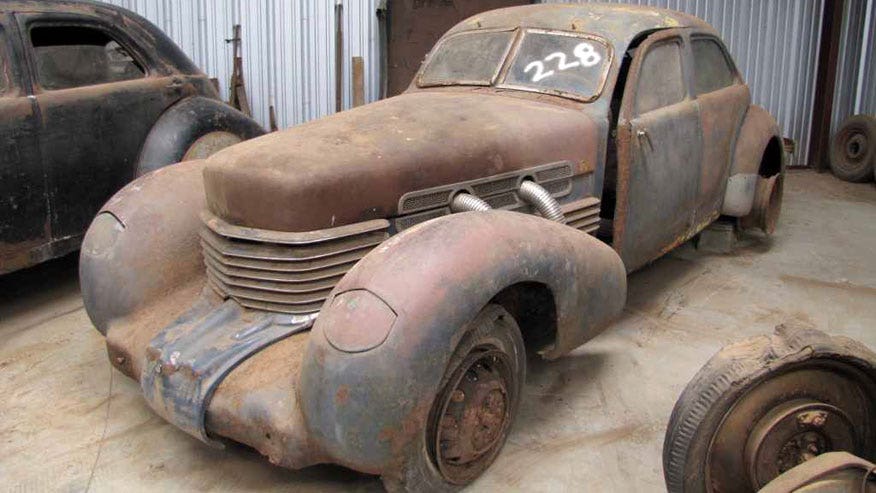
1937 Cord Model 812 Supercharged BeverlyVanDerBrink Auctions
1937 LincolnVanDerBrink Auctions
1937 Terraplane Super SixVanDerBrink Auctions
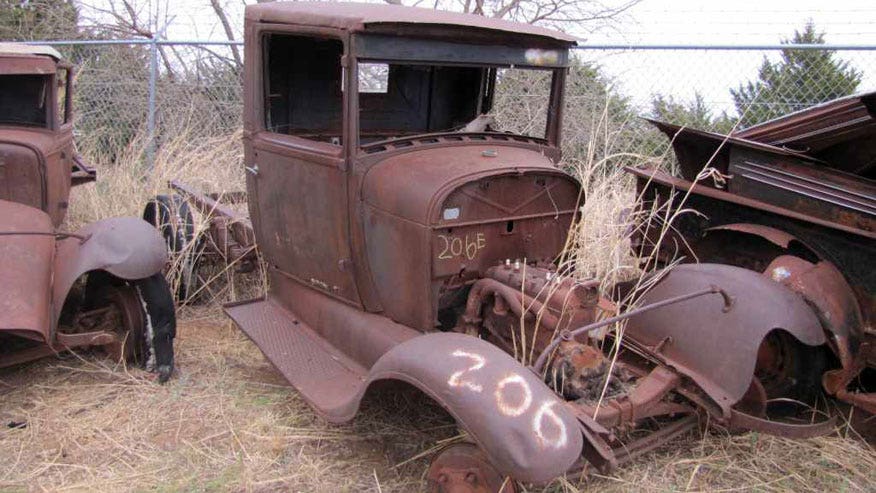
1929 Ford Model A WreckerVanDerBrink Auctions
A collection of more than 200 historic cars hidden from public view for 61 years will be crossing the auction block in Oklahoma next month.
The cars belonged to Oliver Jordan, who ran a salvage business in the city of Enid from 1945 to 1953, when he locked it up during a zoning dispute that lasted for years.
Jordan never relented, and the cars have sat idle since then, most of them left outside to rot. The majority are from the 1930s, and '40s, but the oldest is a rare 1917 Maxwell.
Among the more notable finds are an aluminum-bodied 1937 seven-passenger Lincoln limo by Willoughby, believed to be one of five remaining of the 60 that were produced, and a 1937 Cord Model 812 Supercharged Beverly sedan.
Two 1942 “blackout specials” – a Ford and a Chevy – built during World War II, when the government put restrictions on the use of ornamental shiny metal parts, are fitting of the cache’s low profile.
A 1937 TerraPlane Super Six may sound like a flying car, but was from a short-lived brand produced by Hudson. It doesn’t come with a hood, and you’ll be hard-pressed to find an inch of it that’s not corroded.
The same can be said about pretty much all of the other vehicles. Nevertheless, VanDerBrink Auctions is billing the event as a customizer’s dream, as many of the parts from the once-common cars are becoming rarer by the day.
Jordan sold a few of them himself over the years, but not many. According to auctioneer Yvette VanDerBrink, if he invited you inside to see his secret stash, and you were interested in one of the cars, he’d make you a take-it-or-leave-it offer on the spot. No haggling or second chances allowed.
Jordan died in 2003, and his widow died seven months ago. His grandson, who helped consolidate the cars from four different yards in recent years, is overseeing the sale of the estate, including the 1929 Ford Model A wrecker that was Jordan’s first tow truck. The auction is scheduled to take place on June 7, both on site and online.
All sales are final, of course. Jordan wouldn’t want it any other way.
The Porsche 917K from "Le Mans" after a thorough restoration
Few race cars have ever left the mark on the sport that the Porsche 917K did. Designed by Ferdinand Porsche as the ultimate endurance racer, the 12-cylinder monsters could hit 230 mph thanks to the 600 hp lurking just behind the driver's shoulders.
In 1970 and 1971, Porsche won Le Mans back-to-back with the 917 and dominated circuits until rule changes outlawed its design.
Today, Porsche 917Ks have become one of the world's most valuable collector cars, and in a matter of weeks one could fetch more than $15 million thanks to its history with Hollywood and Steve McQueen.
The car that Gooding & Co. will sell at its Pebble Beach auction this August has a long and winding history, although little of it involves racing. Chassis number 24 was one of the first two 917K to ever compete, running at the 1969 Spa-Francorchamps 1000 km where it had to retire due to engine trouble.
A year later, racing boss John Wyer solved the 917's handling problems and used the same car to test for Le Mans, where it set the top speed and first wore the iconic Gulf colors. Factory driver Jo Siffert then bought the car, and when friend Steve McQueen needed vehicles to shoot his movie "Le Mans" during the 1971 race, Siffert loaned him his 917K. In the movie, Siffert's 917K takes the checkered flag after McQueen crashes.
The car would be shown in public again in October 1971, leading Siffert's funeral procession after his death in a British race, and shortly afterwards was bought by a French collector who parked it in a granary for 25 years. It's re-discovery in 2001 was a huge "barn find," and the new owner undertook a meticulous restoration of the car.
What this 917 lacks in competition history it makes up for in authenticity; many 917s were wrecked, thrashed or scavenged for parts, and weren't considered valuable for much of the '70s. Gooding isn't releasing a pre-sale estimate, but the McQueen touch has proven to be as important, if not more desirable, than a racing pedigree with other models.
The most expensive Porsche auctioned to date was a 917 that brought $4.4 million in 2012, but a Ford GT40 that McQueen used as a camera car for "Le Mans" brought $11 million that same year. Other 917s in private hands have been valued at more than $10 million, and market trends have shown buyers willing to break all known records for a chance to own rolling pieces of racing, and Hollywood, history.